
Splits are emerging on the Spanish right as to what exactly makes someone a Spaniard and whether or not this should allow them to benefit from a far-right 'national priority' policy proposal.
If you follow Spanish politics and have been able to ignore the countless corruption scandals engulfing both the government and opposition parties at the moment, you'll know that immigration is a major talking point.
Much of it will be about the Socialists government's controversial migrant amnesty that will give legal status to up to 800,000 undocumented migrants. But in that debate, you might've also heard the term 'national priority'.
This is a policy proposal by far-right Vox that has proven pivotal in recent regional election negotiations and may give some insight into what a future right-wing coalition government could look like at the national level.
Polls suggest this is the likely outcome of Spain's next general election, slated for sometime in 2027.
READ ALSO: How Spain's mass regularisation of undocumented migrants will work
The idea, which essentially prioritises Spaniards over foreigners for access to housing and state aid, has caused controversy with left-wing parties and the Catholic church. It's also shed light on ideological differences between not only the PP and Vox, but also different wings within each party.
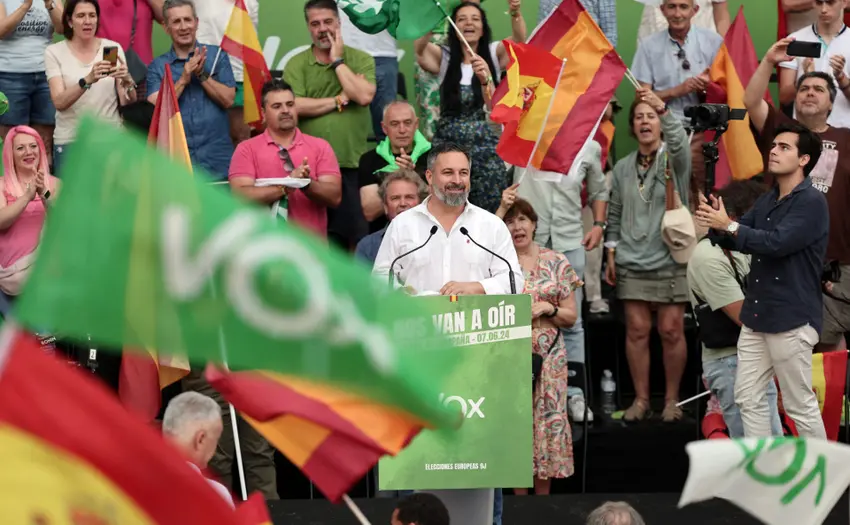
Vox leader Santiago Abascal recently reiterated what he sees as a need for the “national priority” policy. "The recipe is simple: Spaniards first," he said while on the campaign trail in Andalusia.
However, Vox has in recent weeks and months shown itself to be split, or, at the very least, home to different opinions, on what 'national priority' actually is and should be. Similarly there are competing ideas of what Spanish-ness is and what it takes to become a Spaniard.
The concept was then much debated following the recent investiture agreements in Extremadura, Aragón and Castilla y León following regional polls.
With PP leaders concerned about losing voters to Vox on its right flank, Santiago Abascal’s party has succeeded in introducing the 'national priority' policy into four PP-led regional governments in the space of just a few weeks, underlining the likelihood that the PP will not win an absolute majority and will need to govern with Vox in some arrangement.
Recently, a deal was also struck in Valencia where Vox will support regional president Juan Francisco Pérez Llorca to get the regional government’s budget passed in exchange for incorporating the same national priority principle in the region.
Put forward by Vox and accepted, albeit with some reservations and differing interpretations by the PP, the proposal basically seeks to introduce new criteria for access to public services and social benefits.
This stance has clashed with some factions within the PP and comes as immigration has been front and centre of Spanish debate in recent years.
For many in the PP, especially on the moderate wing, the connection is about rewarding a citizen’s ties to a region regardless of nationality and is rooted more in the legal arraigo rather than bloodline.
Looking at the agreement made in Extremadura, Article 7 stipulates that access "to all public aid, grants and benefits" shall be guided by the principle of national priority, which aims to ensure the "priority allocation of public resources to those who have a genuine, lasting and verifiable connection with the territory".
READ ALSO: Spain's Vox mirrors UK far right with protests against migrant centres
Other regions have, for now, seemed to follow the Extremadura framework by including a commitment to national priority, but dressed up in vague language open to interpretation in the future.
But the split is not only between PP and Vox.
These regional government negotiations, along with contradictory statements from Vox leaders themselves, have shown that many in the far-right party itself aren't even clear on what 'national priority' actually means nor what a Spaniard is.
Some Vox members view Spanish-ness in more ethnic terms, while others view it legalistically.
Back in April, Joan Garriga, spokesperson for Vox in the Catalan Parliament, stated that, in his view, a Spanish national is someone who has been “born to a Spanish father and mother”.
Clearly, this definition of Spanish-ness contradicts the constitutional definition, which states that provided at least one parent is Spanish, if the child is born in Spain, they will also be legally Spanish. Of course, there are also several ways to acquire Spanish citizenship and become Spanish too.
Some within Vox disagree with Garriga's definition of Spanishness.
Ignacio Garriga (same surname but not related), Secretary General of the party and himself from a migrant background, stated during an interview on state broadcaster RTVE that he considers Joan Garriga’s interpretation to be a “mistake in terms of current legislation”.
READ ALSO: Why do many figureheads of Spain's far-right Vox have foreign surnames?
“Spanish law states that anyone holding a DNI (Spain's national ID) is Spanish. There are people who do not have a Spanish father or mother and yet end up being Spanish," he added.
He did go on to say, however, that “the time will come” on requirements for obtaining Spanish citizenship as, he suggested, “it is currently being given away”.
This is a common criticism of the Spanish right in recent years.
READ ALSO: Spain grants citizenship to 300,000 foreigners in one year
Ignacio Garriga, who is the son of a father of Belgian descent and a mother from Equatorial Guinea, also acknowledged that there are difficulties in implementing the 'national priority' policy, but nonetheless defended the constitutionality of the idea.
Like with who or what constitutes a Spaniard, Vox is also considering different ways to apply national priority criteria when awarding state aid or benefits.
Among them, the party proposes taking into account length of time registered on the council’s electoral roll, years of study in the area, or the parents’ place of residence.
“We are not prioritising based on passport," Garriga said. "We have discussed the length of time registered".
Some in his party clearly don't agree.
Whatever comes of the policy, polls suggest that a PP-Vox coalition is likely at the national level and how its implemented - if it's implemented at all - might be a look ahead to the future with the Spanish right back in government.
READ ALSO: PP proposes foreigners sign 'letter of commitment' to live in Spain
Comments